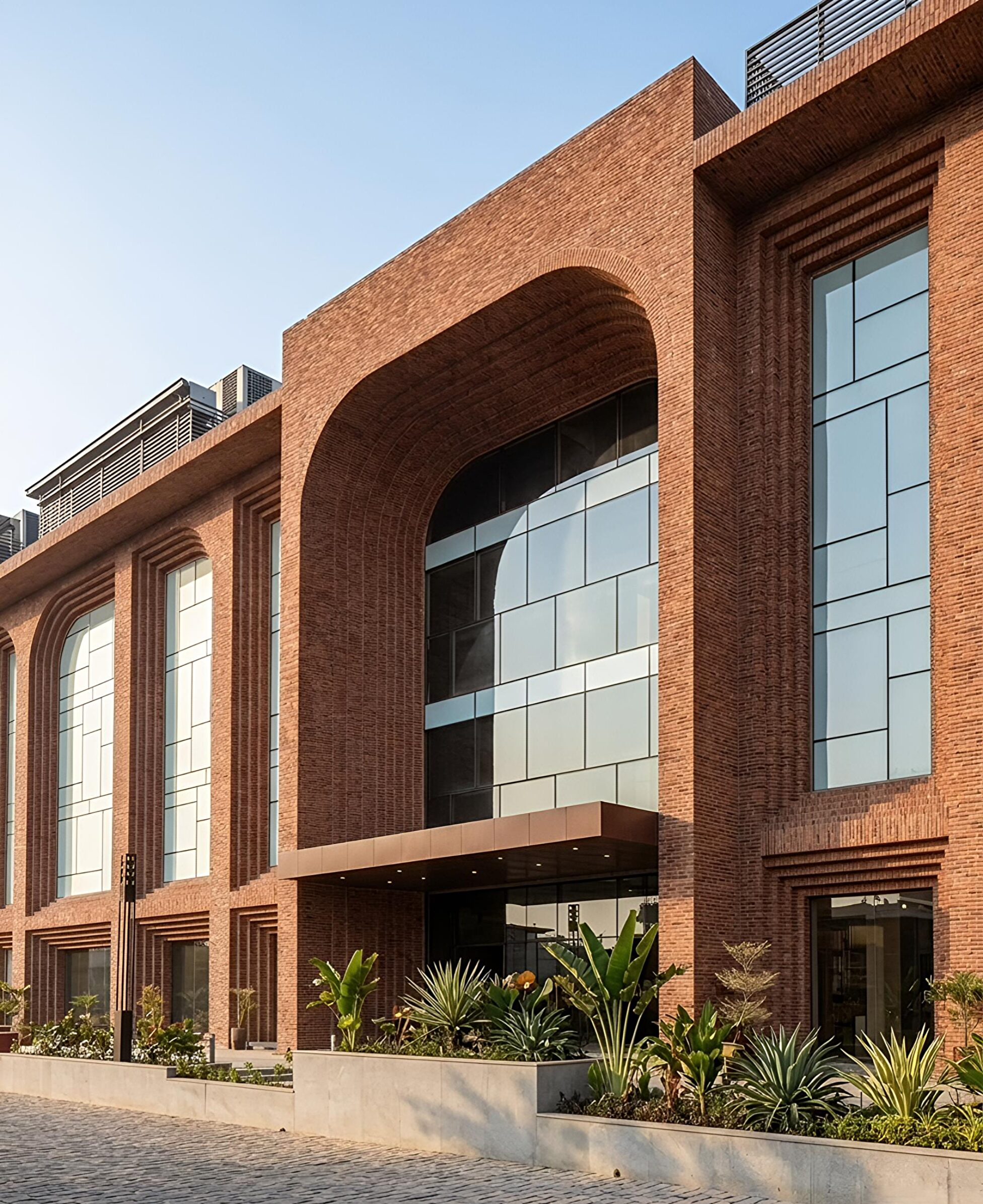
The Outlet Mall of India’s Facade Challenge
At the start, the facade brief was clear: deliver a very large package, keep the finish quality consistent, and support a retail project working to a tight opening schedule. That meant the fabrication plan had to be sharper than usual.
There was another layer to it. The team had to manage many finish combinations while still giving installers a predictable sequence on site. With the right specifications locked early, the challenge shifted from “can this be made?” to “can this be made fast, cleanly, and in the right order?”
Project Scope: 2 Lakh Sq Ft and 68 Days Breaking Down the Numbers
The headline numbers tell you why this facade package stood out: 68 days, nearly 2 lakh sq ft, and 35+ color and finish variations. In normal thinking, each one of those factors adds pressure. Put them together, and the fabrication effort becomes a coordination problem as much as a manufacturing one.
| Metric | Project Figure | Why It Mattered |
|---|---|---|
| Facade area | Nearly 2 lakh sq ft | Very large production volume in a short window |
| Timeline | 68 days | Left little room for rework or delays |
| Color and finishes | 35+ variations | Increased sequencing, tracking, and QC demands |
| Site interface | Installers-driven sequencing | Required output to match installation order |
What made the job extraordinary was not just the size. It was the combination of scale, finish complexity, and the need to give installers ready-to-fit facade components in the right sequence, without slowing the site team down.
Why Fast-Track Facade Cladding? Retail Timelines and Client Expectations
Retail projects do not treat the facade as a background package. It directly affects opening readiness, brand appearance, and the customer experience. That is why fast-tracking was necessary here. The client needed speed, but not at the cost of finish quality or the right specifications.
There was also a practical reason. When facade work slips, connected trades feel the impact. Choosing the right material early and fixing approvals sooner creates a cleaner path for downstream activity.
- Opening schedules in retail leave little tolerance for delayed exterior completion.
- Client expectations usually combine visual impact, repeatable quality, and reliable delivery.
- Fast decisions on materials and specifications reduce late-stage disruption.
In short, speed was not just a manufacturing target. It was a business requirement tied to launch timing, site coordination, and the need to present a complete, polished facade when the project reached handover.
Strategic Production Planning for Large-Scale Facade Manufacturing
Large-scale fabrication rarely succeeds through raw output alone. This project worked because production planning focused on sequence, handoffs, and reducing variability in the process from the beginning. The team did not start with a simple question such as factory produce today?
Instead, the planning logic worked backward from installation needs. That changed how capacity, batching, finishes, and dispatch were organized. Once the workflow was built around real site demand, the factory could move with more control. The next sections explain how that planning approach shaped the result.
Reverse Engineering: Planning Backwards From Installation
Production Was Planned Backwards from Installation. That idea sounds simple, but it changes everything. Instead of asking factory produce today?, the team started with the installation sequence, delivery windows, and site priorities. Then fabrication targets were built to support those needs.
This approach reduced mismatch between what was produced and what installers actually needed next. It also helped control storage pressure, handling risk, and confusion around mixed colors and finishes. When site logic drives factory logic, the whole chain becomes easier to manage. Each step had to support a final installation date, not just hit an isolated internal milestone. For a facade package of this size, that backward view created the discipline needed to keep 68 days realistic.
Defining Capacity: Optimizing Factory Output and Workflows
How much can the factory produce today? That question matters, but it was not enough for this project. Capacity had to be defined in a more useful way: how much approved, traceable, correctly finished facade material could move through fabrication and still match site sequence.
The team improved output by organizing work to reduce variability in the process. That meant less confusion between finish types, fewer interruptions, and better alignment between production and dispatch.
- Capacity was tied to approved drawings, finish readiness, and delivery sequence, not just machine hours.
- Workflow planning focused on smoother batching so mixed finishes did not create avoidable slowdowns.
- Output improved when the factory matched real installation demand instead of building stock without sequence.
So yes, factory capacity mattered. But the smarter move was to treat capacity as a coordinated system. Once workflows were aligned, production became more stable, and the facade package could move at the pace the project required.
Materials, Technologies and Design Choices
Material and finish decisions were central to this facade package. On a project with 35+ variations, the right material was never just about looks. It had to support repeatable fabrication, predictable quality, and a workflow that kept reducing variability in the process.
Just as important, the right specifications had to be fixed early enough to avoid production drift. Color, finish, and panel logic had to work as production inputs, not late-stage preferences. That made design choices part of the factory strategy, which leads directly to the next two areas.
Selecting Cladding Materials: Performance, Cost, and Aesthetics
For any facade package, material selection affects far more than appearance. The compiled information shows a consistent principle: the right material must be chosen early because it influences structural load, performance, fabrication flow, and long-term maintenance. It is not an aesthetic choice alone.
That same logic applies here. With a short timeline and a wide finish range, the team needed materials that could meet the right specifications while still supporting controlled factory production. A poor choice would have increased handling issues, delayed approvals, or forced more site adjustment.
Technology also matters when material choices are locked. Digital design-to-fabrication workflows, pre-verified tolerances, and factory-based checks help turn material decisions into reliable output. For a fast-track facade job, the winning combination is usually simple: choose the right material early, define the specifications clearly, and make sure the production system can repeat that result at scale.
35+ Colors and Finishes: Treating Color as a Process Parameter
Colour Was Treated as a Process Parameter. That was essential on a facade package with 35+ variations. If color is handled casually, production slows down, errors rise, and the chance of mismatch grows. The smarter move is to treat each finish like a controlled input within fabrication.
This helps with reducing variability in the process because teams stop thinking of color as decoration added at the end. Instead, finish becomes part of planning, batching, labeling, checking, and dispatch.
- Each color and finish needed clear identification tied to production and delivery sequence.
- Batching similar finish requirements helped keep fabrication flow more stable.
- QC had to confirm not only dimensions but also surface consistency and finish accuracy.
- Dispatch planning had to prevent mixed-finish confusion before material reached installers.
That process view matters. Once color becomes a tracked production parameter, the facade system becomes easier to control, and finish complexity stops being a constant source of disruption.
Key Challenges During High-Speed Production
High-speed fabrication creates pressure points beyond the shop floor. On this project, the real challenge was keeping information, materials, finishes, and deliveries moving together without losing control. Asking factory produce today? was only one part of the answer.
The bigger issue was keeping the entire supply chain aligned while reducing variability in the process. Raw materials, approvals, finish tracking, and dispatch timing all had to stay synchronized. That is why communication mattered so much. The next two sections look at where the friction appeared and how the team worked around it.
Supply Chain Coordination: Sourcing, Scheduling, and Logistics
Delivering nearly 2 lakh sq ft on time required the supply chain to work as one system. The right material had to arrive in sync with fabrication needs, and finished components had to leave the factory in the order the site could actually use them. That reduced congestion and avoided unnecessary reshuffling.
Scheduling was just as important as sourcing. A delay in one input can slow many downstream activities, especially when multiple finishes are involved. The team had to align production timing with transport readiness and site receiving capacity.
- Material inflow had to support production batches without creating gaps or overload.
- Dispatch sequencing had to match installation priorities, not just warehouse convenience.
- Close coordination across teams helped spot issues before they turned into schedule loss.
In projects like this, logistics is not a final step. It is part of the facade production strategy. When sourcing, scheduling, and delivery work together, the whole package moves faster and with fewer surprises.
Overcoming Bottlenecks: Beyond Factory Capacity
Capacity Wasn’t the Only Bottleneck. A factory can have enough machines and labor on paper and still miss a schedule. This project showed that flow problems often come from approvals, finish complexity, sequencing gaps, or poor handoffs between teams.
That is why the question factory produce today? had limits. Daily output means little if the wrong items are being made, if finish tracking is unclear, or if the site is not ready for dispatch. Reducing variability in the process was the bigger priority because stable flow beats isolated bursts of production.
The team had to work around these hidden bottlenecks by making planning tighter and communication faster. In practice, that meant treating fabrication, QC, and logistics as connected activities. Once those links improved, the project could move at speed without relying on last-minute corrections.
Quality Assurance in Large-Scale Cladding Projects
Fast production only works when quality stays controlled. On a facade package this large, small errors can multiply quickly. That is why reducing variability in the process is also a quality strategy, not just a speed strategy.
The goal was to keep every panel aligned with the right specifications before it reached site. Factory verification matters because it avoids expensive correction later. For large projects, quality assurance is not one final inspection. It is a chain of checks built into production, handling, and dispatch. The next sections explain that thinking in more detail.
Ensuring Consistent Quality Across Panels
Consistent quality starts long before the final check. The compiled information shows a clear lesson from factory-based facade work: digital precision, controlled fabrication, and verification at source create better outcomes than relying on field adjustment. That thinking shaped how consistency had to be protected here.
With a short schedule, the team needed checks that kept reducing variability in the process. Every panel had to stay aligned with the right specifications for size, finish, and readiness before dispatch. In a fast-track environment, prevention matters more than correction.
- Production checks had to confirm dimensional accuracy before panels left the factory.
- Finish reviews had to catch color and surface variation early, especially across mixed batches.
- Traceability helped ensure each fabricated unit matched the correct sequence and location logic.
The result is simple but powerful: when quality is built into fabrication, installers receive facade elements that are ready to connect rather than items that still need interpretation or repair on site.
Factory QC Versus Site Remediation : Why it Matters
Factory QC Versus Site Remediation—Why it Matters is one of the biggest lessons from large-scale facade production. A defect found in the factory is usually a manageable problem. A defect found after delivery or installation affects time, labor, access, and cost all at once.
The compiled information makes this point clearly: factory fixes cost far less than site remediation. Once installers are involved and a panel is already at height or integrated into the build, even a small issue becomes harder to resolve. That is why strong QC at source protects both schedule and budget.
For this project, factory-based checks supported speed because they reduced uncertainty. Installers could focus on connecting the facade rather than measuring, adjusting, and solving avoidable problems in the field. That shift is critical on a 68-day program, where every saved hour on site has real value.
Conclusion
In conclusion, the successful execution of the Outlet Mall of India’s façade cladding project showcases the intricate balance between speed and quality in large-scale manufacturing. By strategically planning production, optimizing workflows, and ensuring rigorous quality assurance, we were able to meet the ambitious timeline of 68 days while delivering exceptional results. The journey involved overcoming significant challenges, but the lessons learned can benefit architects and developers looking to tackle similar projects. For those interested in exploring how we can help you achieve your façade goals, feel free to reach out for a free consultation. Let’s collaborate to bring your next vision to life!